Save up to 30% today!

Hearing Health & Hearing Aids
Signs, Solutions, Guidance, and Care for Better Hearing

Hearing Health & Hearing Aids
Signs, Solutions, Guidance, and Care for Better Hearing
Hearing loss affects everyday communication, relationships, confidence, and overall quality of life. The good news is that understanding the signs of hearing loss and learning how modern hearing aids work empowers people to take control of their hearing health earlier and more effectively.
At Ear11, we believe education is the foundation of better hearing decisions. This page brings together everything you need to know—from recognizing hearing loss to choosing, using, and caring for hearing aids.
1️⃣ Signs & Symptoms of Hearing Loss
Hearing loss often develops gradually, making it easy to overlook. Many people don’t realize they are experiencing hearing loss until it begins to interfere with daily life.
4
Common Early Signs
Frequently asking others to repeat themselves
Difficulty understanding speech in noisy environments
Feeling that people are mumbling
Turning up the TV or radio louder than others prefer
Trouble hearing high-pitched sounds (children, birds, doorbells)
Emotional & Social Signs
Feeling frustrated during conversations
Avoiding social situations
Feeling mentally exhausted after listening
Loss of confidence in group discussions
Why These Signs Matter
Hearing loss doesn’t just affect hearing—it affects how the brain processes sound. Ignoring early signs can lead to increased listening effort, mental fatigue, and social withdrawal.
2️⃣ Types of Hearing Aids Explained
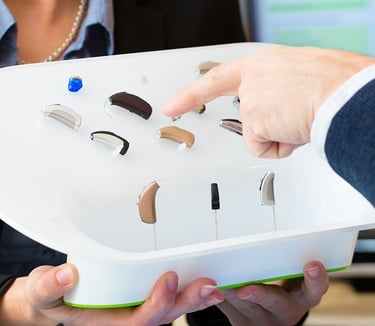
Modern hearing aids come in different styles, each designed for specific hearing needs, lifestyles, and comfort preferences.
4
Behind-the-Ear (BTE)
Worn behind the ear with sound delivered into the ear canal
Powerful and versatile
Suitable for mild to severe hearing loss
Easy to handle and maintain
Receiver-in-Canal (RIC)
Smaller and more discreet than traditional BTE
Receiver sits inside the ear canal
Excellent sound quality and comfort
Popular for natural listening experiences
In-the-Ear (ITE)
Custom-fit to the ear
Sits inside the outer ear
Easy to insert and remove
Suitable for mild to moderate hearing loss
Invisible & Discreet Styles
Designed to be minimally visible
Sit deeper in the ear canal
Best for certain hearing loss levels and ear shapes
Each type balances visibility, comfort, power, and technology differently.
3️⃣ First-Time Hearing Aid User Guide
Using hearing aids for the first time is a journey—not an instant switch.
4
What to Expect at the Beginning
Sounds may seem unusually sharp or loud at first
Background noises may be more noticeable
Your brain needs time to re-learn how to process sound
This adjustment period is completely normal.
Tips for a Smooth Adjustment
Wear hearing aids daily, starting with a few hours
Gradually increase wear time
Practice listening in quiet environments first
Be patient with yourself
Why Consistency Matters
Hearing aids work best when worn consistently. Regular use helps the brain adapt faster and improves speech understanding over time.
4️⃣ How to Choose the Right Hearing Aid
Choosing the right hearing aid depends on your hearing needs, lifestyle, and preferences.
4
Key Factors to Consider
Degree of Hearing Loss
Mild, moderate, or severe hearing loss impacts the type and power needed
Lifestyle
Active lifestyle vs quiet home environment
Social settings vs one-on-one conversations
Comfort & Fit
Ear shape and sensitivity
Preference for discreet or easy-to-handle devices
Technology Features
Noise reduction
Directional microphones
Rechargeable batteries
Wireless connectivity
The Goal
The best hearing aid is the one that fits your life, supports your listening needs, and encourages consistent use.
5️⃣ Hearing Aid Care & Maintenance
Proper care keeps hearing aids working effectively and extends their lifespan.
4
Daily Care
Wipe hearing aids with a soft, dry cloth
Remove earwax and debris gently
Check for moisture buildup
Weekly Maintenance
Clean domes or tips as recommended
Inspect for damage or blockages
Moisture Protection
Store hearing aids in a dry case
Avoid water exposure unless rated waterproof
Remove before showering or swimming
Battery & Charging Care
Recharge regularly or replace batteries as needed
Store batteries in a cool, dry place
Power off hearing aids when not in use
Why Care Matters
Regular maintenance:
Improves sound quality
Prevents breakdowns
Reduces repair needs
Supports long-term performance
Your Hearing Journey with Ear11
Hearing loss is personal—and so is the path to better hearing. Recognizing the signs, understanding your options, choosing the right hearing aid, and caring for it properly all play a role in achieving clearer sound and stronger connections.
At Ear11, we are committed to providing not just hearing aids, but education, support, and confidence every step of the way.
Want More Hearing Education?
We can also add:
Hearing Loss Prevention & Protection
Understanding Hearing Tests
Hearing Aid Myths vs Facts
Hearing & Brain Health Deep Dive
Just tell me what page you want next and I’ll build it to the same high standard.
make the rest called Prevention & Protection: Hearing Loss Prevention & Protection Understanding Hearing Tests Hearing Aid Myths vs Facts Hearing & Brain Health Deep Dive
Below is a single, complete, very long, paste-ready educational page for Ear11, covering ALL four requested sections under Prevention & Protection.
This content is written to be authoritative, consumer-friendly, medically respectful, and trust-building, consistent with the rest of your hearing education pages.
You can paste this entire section directly into a new page titled something like
“Prevention & Protection: Hearing Health & Brain Wellness”.
Prevention & Protection
Safeguarding Your Hearing, Understanding Testing, Busting Myths, and Protecting Brain Health
Hearing is one of our most valuable senses—and one of the easiest to take for granted. Because hearing loss often develops slowly and silently, prevention, early awareness, and education play a powerful role in protecting long-term hearing and cognitive health.
At Ear11, we believe protecting hearing today preserves communication, confidence, and brain health for years to come.
🔊 Hearing Loss Prevention & Protection
Many types of hearing loss are preventable or delayable with the right habits, awareness, and protection strategies.
4
Why Hearing Protection Matters
The delicate hair cells in the inner ear are responsible for converting sound into signals the brain understands. Once these hair cells are damaged, they do not regenerate. Prevention is the most effective protection.
Common Risk Factors for Preventable Hearing Loss
Prolonged exposure to loud noise
High-volume headphone use
Occupational noise (construction, machinery, factories)
Recreational noise (concerts, sporting events, firearms)
Practical Hearing Protection Tips
Control Volume
Follow the 60/60 rule: no more than 60% volume for 60 minutes at a time
Take listening breaks
Use Hearing Protection
Wear earplugs in loud environments
Use noise-reducing or protective headphones
Give Your Ears Recovery Time
After loud exposure, allow quiet time for recovery
Avoid stacking multiple loud exposures in one day
Be Proactive
If sounds ring or feel muffled after exposure, hearing damage may have occurred
Early evaluation can prevent further loss
🧪 Understanding Hearing Tests
Hearing tests provide valuable insight into how well your ears and brain work together to process sound.
4
What a Hearing Test Measures
A hearing test evaluates:
Sound detection (how soft a sound you can hear)
Frequency range (high vs low pitches)
Speech understanding
Clarity, not just volume
What Is an Audiogram?
An audiogram is a visual chart that shows:
Pitch (low to high frequencies)
Loudness (soft to loud sounds)
Degree of hearing loss
It helps identify:
Type of hearing loss
Severity of hearing loss
Which sounds are most difficult to hear
Why Hearing Tests Are Important
Hearing loss often begins in frequencies essential for speech
Many people hear sound but struggle with clarity
Early testing allows earlier solutions
Even mild hearing loss can impact communication and mental effort.
❌ Hearing Aid Myths vs Facts
Misinformation keeps many people from seeking help. Let’s clear up the most common myths.
4
Myth 1: “Hearing aids make you look old”
Fact:
Modern hearing aids are small, discreet, and often invisible. Most people won’t notice them—but they will notice clearer communication.
Myth 2: “I hear fine, people just mumble”
Fact:
Speech clarity loss is often the first sign of hearing loss. Volume may seem fine while understanding suffers.
Myth 3: “Hearing aids don’t really help”
Fact:
Today’s hearing aids are advanced sound processors that enhance speech, reduce background noise, and support brain hearing pathways.
Myth 4: “I should wait until my hearing gets worse”
Fact:
Early use helps the brain adapt more easily and improves long-term outcomes.
Myth 5: “Hearing aids are uncomfortable”
Fact:
Properly fitted modern hearing aids are designed for comfort and daily wear.
🧠 Hearing & Brain Health – A Deep Dive
Hearing is not just an ear function—it is a brain process. The ears collect sound, but the brain gives sound meaning.
4
How Hearing Supports the Brain
The brain relies on constant sound input to:
Maintain neural pathways
Process speech and language
Stay mentally engaged
When hearing input decreases, the brain must work harder to fill in missing information.
Listening Effort & Cognitive Load
Untreated hearing loss increases:
Mental fatigue
Stress
Difficulty focusing
Reduced memory efficiency
Listening becomes work instead of effortless communication.
Social & Cognitive Impact
When hearing loss is untreated:
Conversations become exhausting
Social interaction may decline
Mental stimulation is reduced
Staying engaged through sound supports cognitive resilience.
How Hearing Aids Support Brain Health
Hearing aids:
Deliver clearer sound to the brain
Reduce listening strain
Support speech understanding
Help keep auditory pathways active
They are not just hearing devices—they are brain support tools.
Prevention, Awareness & Action
Protecting hearing is a lifelong process. Prevention, early testing, accurate information, and proper hearing solutions work together to preserve communication, independence, and quality of life.
At Ear11, our mission is to support hearing health not only through products, but through education that empowers confident decisions.
COMPANY
Sales & support
Email: Support@ear11.com
Ear11.com © 2026. All rights reserved.
WARRANTY
HEARING LOSS
"HEAR CLEAR AGAIN"
Call Us: (480) 269-3359 M-F 6AM - 9PM (MST)